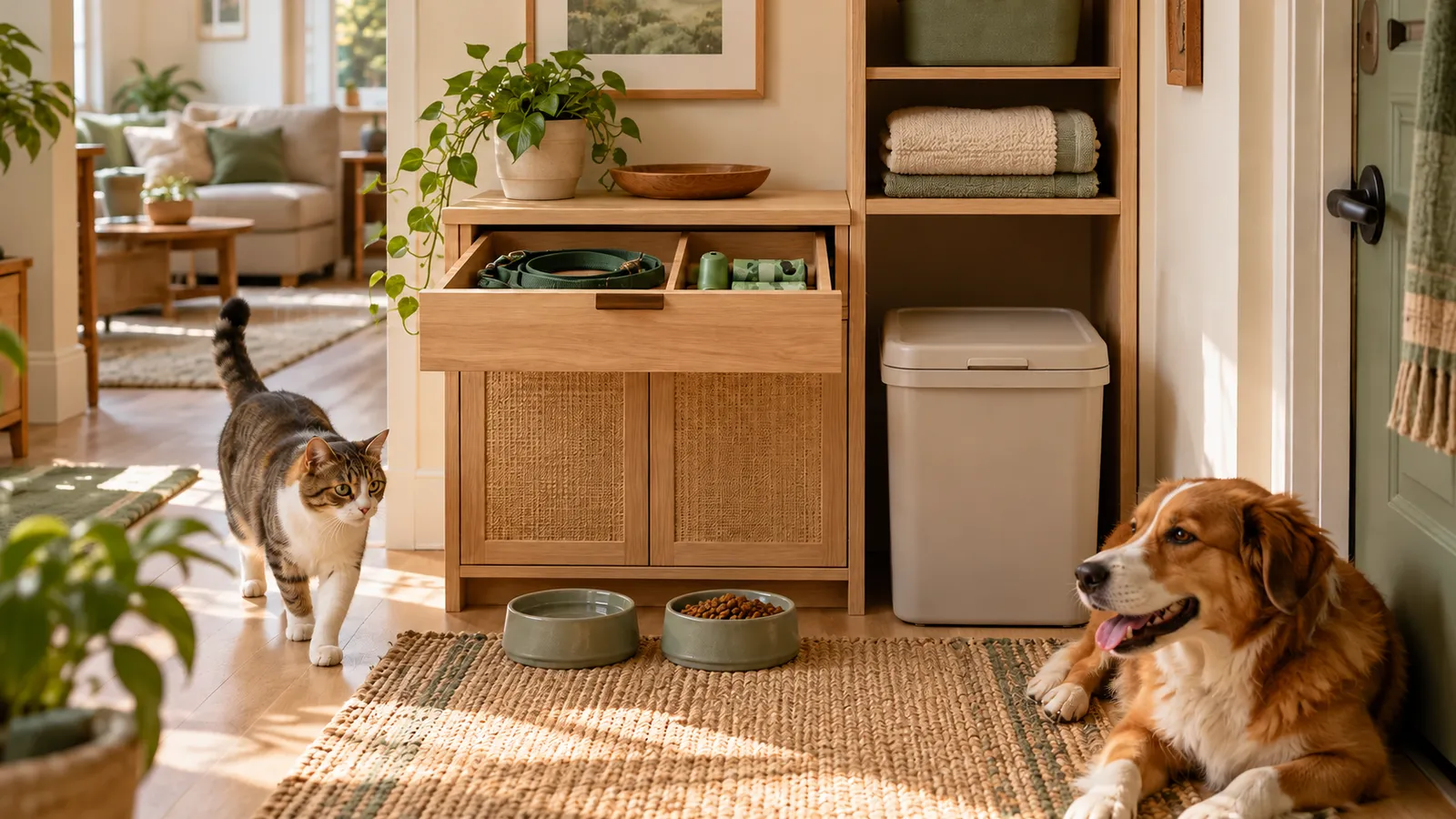
Store pet supplies where you use them, with a small amount of everyday gear within easy reach and backup supplies in a separate, secure spot. Start with the cabinets, shelves, and containers you already own. Before adding an organizer, check whether you can retrieve, use, clean, and put away the supplies without blocking a doorway or your pet’s route.
A small apartment does not need one large pet cabinet. It needs a workable home for each routine: feeding, walks, play, and cleanup. The arrangement below is a planning method, not a tested storage system.
Sort supplies by the next task
Gather the supplies you want to reorganize and sort them into four groups. Keep food and feeding utensils separate from litter tools and cleaning chemicals.
| Routine | Keep ready for daily use | Put in backup storage |
|---|---|---|
| Feeding | Current food, a dedicated measuring utensil, bowls | Unopened food and spare feeding parts, stored as their labels direct |
| Walks | Leash, harness, waste bags, a dry towel | Spare rolls and seasonal gear |
| Play | A small selection of appropriate toys | Other toys and spare parts, secured when needed |
| Cleanup | The supplies needed for the next cleanup | Refills and spare washable layers |
Do not buy matching bins yet. Remove empty packaging, check dates and labels, and identify duplicates you no longer need. Keep product instructions with items that require assembly or special care.
For a new puppy, use the first-week apartment checklist to decide what you need before setting aside space for optional equipment.
Give food its own secure storage location
Choose a cool, dry location that your pet cannot raid. FDA recommends keeping dry pet food in its original bag with the top tightly folded down. If you want an extra storage container, FDA advises putting the entire bag inside it. If you need to pour food directly into another container, use a clean, dry container with a snug-fitting lid. Save the UPC code, lot number, product name and manufacturer, and “best by” date; replace that information when you open a new bag. Wash and dry the container between bags. Follow any additional package directions. See FDA’s storage guidance. See FDA’s handling and storage guidance.
Measure the current bag before assigning a shelf. Can you lift it out, close it again, and return it without tipping nearby supplies? A deep cabinet may hold the bag but make daily access awkward. Move unrelated items first rather than assuming you need a smaller food container.
Keep a dedicated pet-food measuring utensil with the feeding supplies. FDA advises washing bowls and scooping utensils after each use, so include a washing and drying step in the arrangement.
If you use an automatic feeder, leave its refill and cleaning access available. Our automatic cat feeder guide covers the equipment decisions separately; a hopper is not a reason to remove the rest of the food-care routine.
Make the entryway work for departures and returns
Put the leash and waste bags in one predictable place near the exit, provided your pet cannot chew or swallow them. Use an existing drawer or secure cabinet if exposed hooks would leave dangling gear within reach.
Rehearse leaving with keys, a bag, and your pet. Then rehearse coming home with a wet towel or muddy gear. Does the cabinet door open into the path? Would a basket slide into the doorway? Can damp items dry before you put them away?
In a studio with no entry closet, one drawer near the door may work better than a floor-standing organizer. Keep daily gear there and seasonal items elsewhere. This is a hypothetical layout, not a claim about a particular home or product.
Separate toy storage from the play area
Keep a manageable selection of toys available for the activities you supervise. Secure toys or loose pieces that should not be accessible between sessions; storage requirements depend on the item and your pet’s behavior.
A cat wand, for example, needs a place where the cat cannot reach its string and attachments after play. Do not choose an open basket simply because the wand fits inside it. Our small-apartment cat toy guide explains supervised play and storage considerations.
For food-based dog activities, include cleanup before storage. Check each toy’s instructions rather than assuming every fabric mat is machine-washable or every silicone item is dishwasher-safe. See the dog enrichment comparison for those activity choices.
Keep cleanup supplies accessible to you and secured from pets
Assign litter tools and cleaning supplies their own storage areas, separate from feeding supplies. Keep chemicals in their original labeled containers and secure them according to their labels. The AKC puppy-proofing checklist identifies cleaning products and other reachable household hazards as items to secure.
Place clean, dry towels near the task they support. Give used towels a separate laundry destination. Avoid packing damp materials into a closed bin just to make the room look tidy.
A bathroom cabinet may be useful for some cleanup supplies, but first check what else lives there and whether the door can be secured. The litter scoop should not share a container with food utensils. Plan the actual sequence: get the tool, complete the task, clean it as instructed, let it dry where required, and return it.
Use our small-apartment cleaning routine for task frequency. This guide focuses on where the supplies live.
Check the full storage footprint before buying
Measure more than the empty shelf. Include the organizer, its handles or lid, the largest item inside, and the movement needed to retrieve it.
| Storage idea | Useful when | Reconsider when |
|---|---|---|
| Existing drawer | Daily items fit and you can secure access when needed | Items jam the drawer or need drying before storage |
| Shelf container | Contents are easy to lift out and the shelf supports the intended load | Reaching it requires an awkward lift or blocks access to other essentials |
| Rolling cart | You have a dedicated parking spot and can secure unsuitable contents | It crowds a passage or pets can reach food, chemicals, or loose parts |
| Wall organizer | Installation is permitted and suitable for the wall and load | Rental permission, fixing requirements, or safe placement is unresolved |
Follow the exact organizer’s installation and load instructions, including any anchoring requirements. Keep heavy supplies low and avoid arrangements your pet could climb or pull over. Do not assume an adhesive hook can carry a full food bag or that furniture can be drilled without permission.
You may need no new organizer at all. If an existing drawer holds the daily gear and one cabinet holds the backups, stop there.
Try the arrangement through your normal routine
Before making a permanent change, walk through feeding, a departure, a play session, and cleanup. Note each time you move an unrelated item to reach a supply. That is the first place to simplify.
For a shared apartment, label locations by task—“walk supplies” or “clean towels”—so another caregiver can follow the system. Keep backups out of the daily workspace, but write down where they are.
If a setup fails, identify why: too much stock, a blocked opening, unsafe access, or nowhere to dry washed items. Change that part before buying another container.
FAQ
Do all pet supplies need to be in one cabinet?
No. Separate locations can work better when they support different tasks. Keep feeding supplies apart from litter tools and chemicals, and make the locations clear to everyone providing care.
Should I buy a storage cart first?
Sort and measure first. A cart is useful only if it has a parking spot, leaves normal access clear, and lets you secure anything your pet should not reach. Existing furniture may already solve the problem.
Research notes
This article uses source research, not hands-on testing. FDA guidance supports the food-storage and utensil-care statements; AKC guidance supports securing household hazards. The task groups, example layout, tables, and retrieval checks are editorial planning suggestions. Sources were reviewed October 17, 2026. No storage products, prices, or performance results are recommended here.