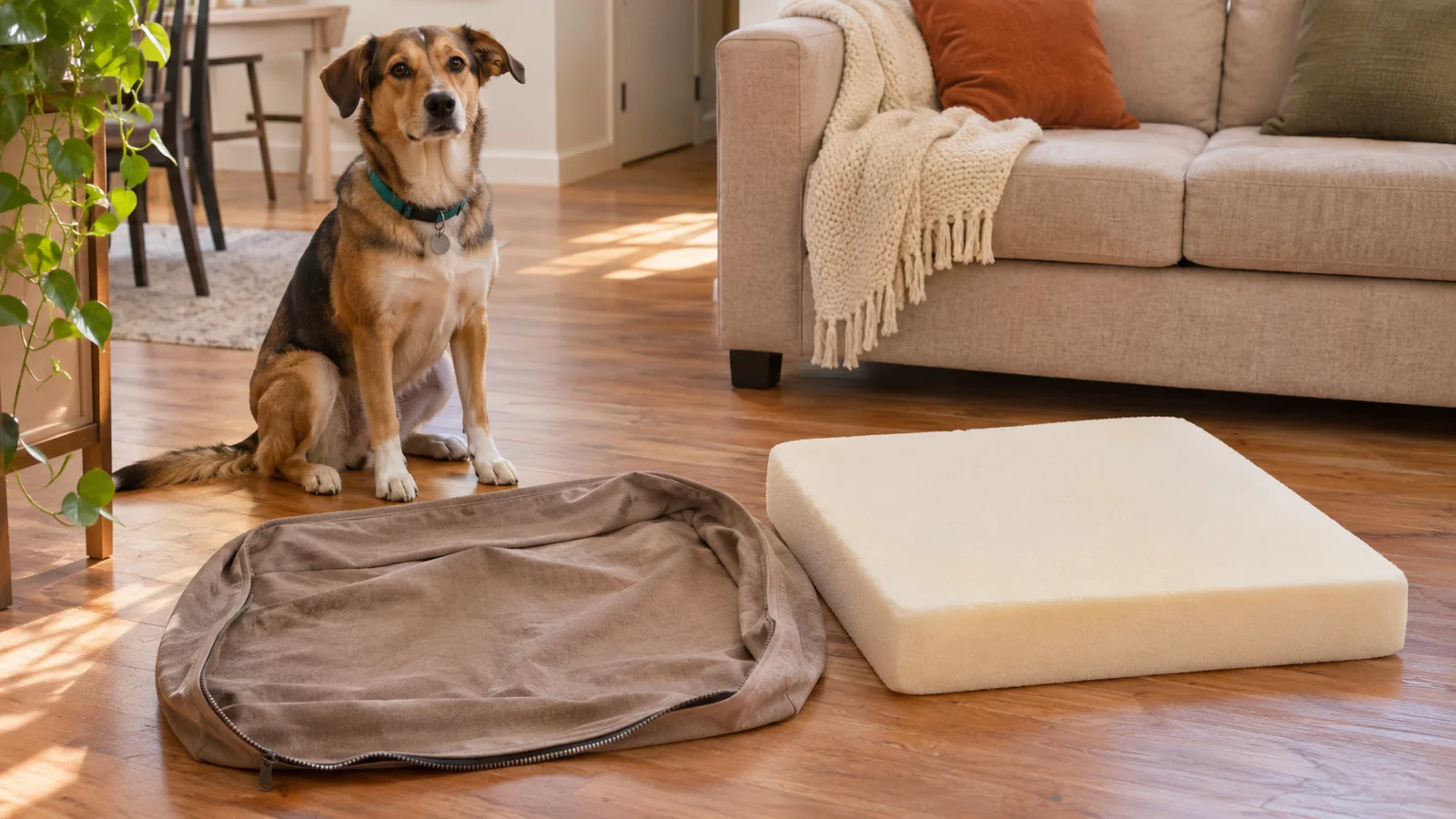
For a bed with a removable cover, take out the inserts as the manufacturer directs before washing the cover. Follow the cover’s care label, then check the foam and liner instructions separately. A washable cover does not mean the whole bed can go in the machine. If you cannot identify the parts or find their instructions, pause before adding water.
For apartment wash day, make one more decision first: where will each washed part dry, and where will your dog rest meanwhile? A clean cover is little help if the bed underneath is still damp.
Separate the cover, liner, and inserts
Unzip the bed only where it is designed to open. Take a quick photo before removing anything so you can put the layers back correctly. Look for a fabric cover, a separate liner, the foam base, and any bolster inserts. Do not cut a sewn compartment open to reach the filling.
| Part | What to check | If instructions are missing |
|---|---|---|
| Outer cover | Whether it can be washed; cycle, temperature and drying method | Find the exact model’s instructions or contact the manufacturer |
| Protective liner | Its own washing and drying rules | Do not borrow the cover’s settings |
| Foam base | Whether cleaning with water is permitted and how | Keep it out of the washer and do not soak it while you confirm |
| Bolsters | Whether they come out and how their filling is cared for | Leave them out of the cover wash; ask for guidance |
These distinctions matter even within familiar brands. FurHaven’s care guide separates indoor fabric covers from coated outdoor covers. The water-resistant liners described in that guide are wipe-clean and must not go in the washer. Barker Beds’ FAQ allows its water-resistant liners to be washed in cool water and hung to dry. These examples apply only to the products covered by those instructions. Use your model’s label rather than transferring settings between brands.
Make a wash-day plan before carrying the cover downstairs
Ask management or the laundry operator whether pet bedding is accepted, whether a particular machine is required, and what cleanup residents should do. A pet-friendly building may still have restrictions in its laundry room.
If bedding is prohibited, find a laundry operator that explicitly accepts it. Removing the hair does not change the rule. If the permitted machine cannot accommodate the cover according to its loading instructions, choose another suitable machine rather than packing it tightly.
At home, reserve a place to dry the cover as its label requires. Choose a spot where it can spread out without blocking your walkway or your dog’s access to water. Set aside a clean, dry resting option your dog already uses.
Remove loose hair before washing
Work over an area you can clean easily. Use a fabric-compatible hair-removal tool or vacuum attachment, paying attention to seams and folds. Avoid rough brushing on delicate fabric or damaged stitching.
AKC’s dog-bed cleaning guide recommends removing excess hair before washing. For the trip downstairs, keep the prepared cover separate from clean laundry. Our shared laundry room guide covers the broader hair-removal and cleanup routine.
Wash the empty cover using its own settings
Check that all removable inserts are out. Follow the label’s instructions for fastening the zipper, pretreating marks, choosing detergent, and setting the machine. Use the detergent dose appropriate for the load and equipment.
Do not select a hotter program just because the cover smells. General cleaning advice does not override a cold-wash label. Likewise, do not assume a stain remover that works on another household fabric is suitable for this cover or its backing.
If the care label permits machine washing, load the cover without overcrowding. Maytag’s guidance makes both label permission and machine fit prerequisites. If the instructions allow only hand washing, follow that process instead; a larger laundromat machine does not make the fabric machine-washable.
Afterward, remove visible hair from user-accessible surfaces and follow the room’s posted cleanup instructions. Report a machine problem to the operator rather than opening service panels or filters residents are not meant to access.
Give the foam a separate decision
If the foam stayed clean and dry, you do not need to wet it simply because the cover is being washed. Keep it in a clean, dry place while you handle the laundry.
If the foam is dirty, look up its specific care method. Maytag notes that some foam inserts are unsuitable for machine washing or full submersion. Permission to hand-wash an entire soft bed should not be treated as permission to soak a foam mattress.
For a model that permits spot cleaning, follow the manufacturer’s directions for the cleaning solution, amount of moisture, and drying. If a mark persists, do not increase the concentration beyond those directions. If urine or another spill has reached deep into the insert and the allowed method does not resolve it, contact the manufacturer about cleaning or a compatible replacement insert.
If you accidentally washed the foam, stop before putting it in a dryer. Explain what happened to the manufacturer and ask whether that insert can be recovered. A dry-looking surface alone does not establish that the interior is ready to use.
Dry the cover without turning your apartment into an obstacle course
Use a dryer only if the cover’s label permits it, at the specified setting. Check any backing or liner instructions too. Do not use heat to shorten a drying method that calls for air drying.
For an air-dry cover, use the arrangement its label allows—hanging or laying it out—with space around the fabric. Avoid folding wet layers into a heap. Keep the setup clear of doors, walkways and your dog’s resting space. If your available spot cannot accommodate it, arrange a suitable drying location before the next wash.
There is no reliable one-size-fits-all drying time here. Fabric, thickness and your drying conditions differ. Check seams, folds and backed sections before reassembly; if any area is still damp, give it more time. Foam that has been cleaned needs its own complete drying process, even if the cover finished hours earlier.
Do not zip a dry cover around a damp insert to reclaim floor space. Use the temporary resting option until every part is ready.
When something still is not right
The cover no longer fits: Check its orientation, the position of bolsters, and whether the correct cover is paired with the insert. Do not force the zipper or soak the cover to stretch it. Ask the manufacturer about fit or possible shrinkage.
The smell returns after washing: Separate the parts again and locate the source. Check the liner, insert, and floor beneath the bed rather than repeatedly washing the outer fabric. Our apartment pet-odor guide helps you work through other nearby sources.
There is nowhere to dry everything: Keep a dry resting option available and clean one washable layer at a time. If the cover alone exceeds your drying space, arrange another suitable location before washing it.
Before putting the bed back together, confirm that the cover, liner and inserts are completely dry and correctly positioned. Then add the task to your small-apartment cleaning routine when a suitable machine and drying space are available.