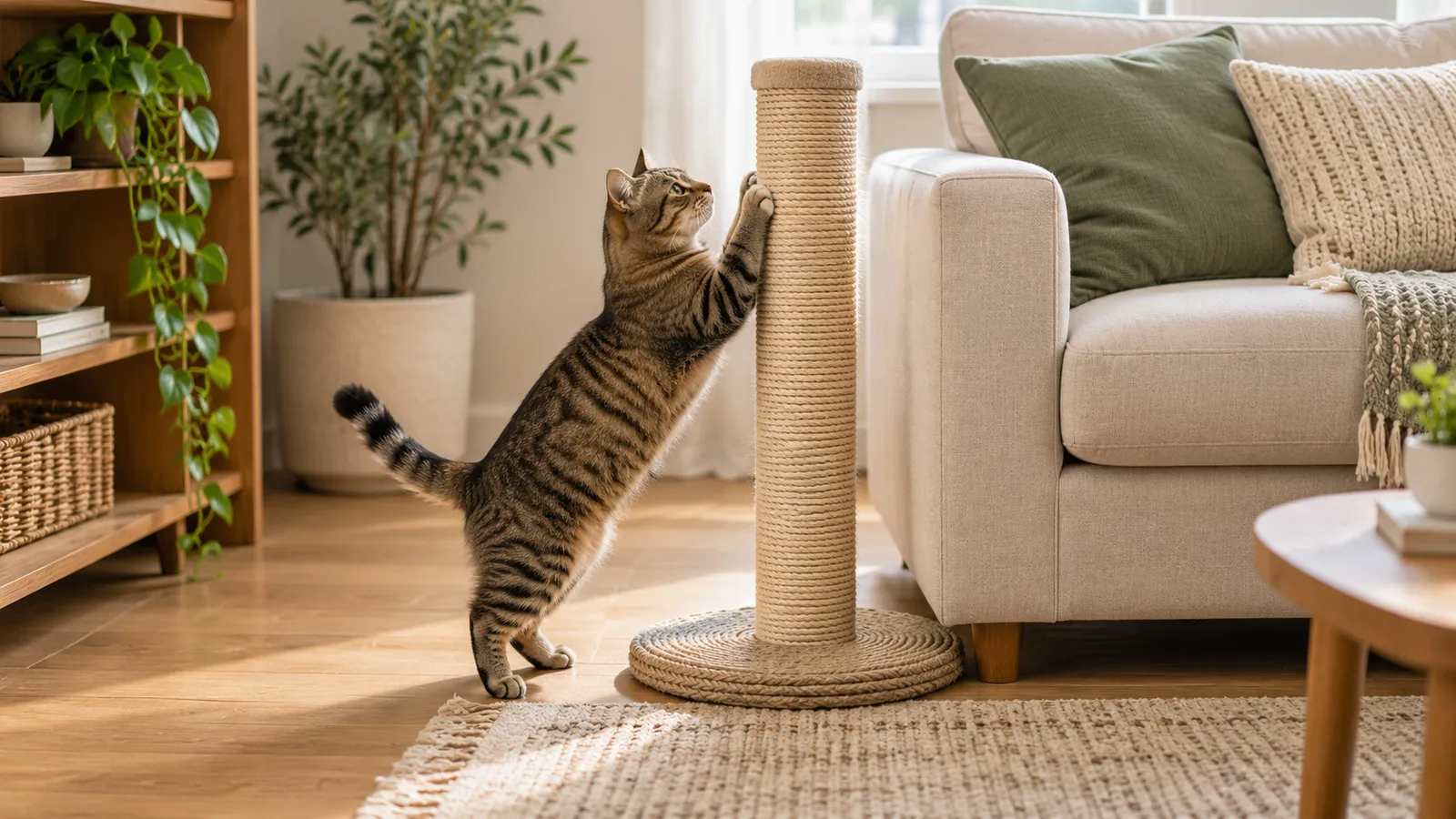
Put the scratching post beside a place your cat already scratches, or near a favorite sleeping spot. Choose a stable position where your cat can approach and stretch without blocking a doorway or your daily walking route. An unused corner is only useful if your cat actually spends time there.
Watch where scratching happens before rearranging the room. If your cat scratches the couch, try beside that spot before choosing a separate “cat corner.”
Start with the spot your cat has already chosen
Scratching is normal cat behavior. It serves several purposes, including stretching and marking. A post gives that behavior somewhere appropriate to happen; it is not a product guarantee that furniture damage will stop. ASPCA’s scratching guidance recommends placing an alternative beside an object the cat scratches.
If your cat works on the front corner of the sofa, start next to that corner. Do not put the post behind the sofa simply because it is easier to hide there. Leave the scratching face accessible rather than wedged between furniture.
If your cat scratches a rug instead, location may be only part of the issue. A horizontal scratcher may suit that behavior better than an upright post. Observe the surface and direction your cat chooses before buying something different.
Four apartment situations—and how to choose
Your couch sits beside the main walkway
Try the outside of the sofa arm, provided the base stays out of the route between the door and seating. Open nearby doors and walk through carrying a laundry basket. If you have to step around the base, reconsider the arrangement.
When there is no usable space at that corner, look at moving a side table or shifting the seating slightly. A narrower-looking post is not automatically a solution: its base still needs to support it. Follow the assembly instructions rather than reducing or modifying the base to squeeze it in.
The space needed depends on your room and the assembled item; there is no fixed clearance measurement for every setup.
Your cat naps on a chair or beside the bed
A spot near the resting area is another sensible starting point. San Francisco SPCA notes that cats often scratch after waking and recommends a post near their sleeping area.
In a studio, that might mean beside the chair where your cat sleeps rather than beside your own bed. Keep access to drawers, closet doors, and the bed clear. Avoid a position where you would regularly move the post out of the way; choose a place that works during everyday use of the room.
Your cat spends time by the window
A window-side spot is worth considering if your cat already rests or scratches there. The window itself does not make it a better location. Keep the base on a level floor with an accessible scratching face, and keep the setup clear of blind cords, doors, and the walking route. Do not use the post to prop open a window or assume a scratching post is a climbing perch. These are household layout checks, not a claim that cats universally prefer windows.
The only spare corner is near the litter box
Do not treat the litter-box area as the default location for every cat supply. First check whether your cat rests, passes through, or scratches there. Then check whether the post would narrow the route to the box or make scooping awkward.
If that corner is merely leftover space, a position near an existing scratching spot is a better starting experiment. Our litter-box placement guide covers the separate task of planning box access. Keep the route usable rather than relying on an arbitrary distance between supplies.
Fit the scratching surface to the cat, then fit it to the room
A vertical post needs to remain steady during use and allow a full stretch. The ASPCA also notes that cats differ in preferred surface and orientation.
Before choosing a post, compare its assembled base dimensions with the available floor area. Include projecting parts and the space your cat needs to stand at the scratching face. For a horizontal scratcher, check the whole usable surface, not just its storage dimensions.
A practical way to evaluate the footprint is to mark it temporarily on the floor using a method suitable for that flooring, then remove the marks after checking the room. Do not leave loose material where a pet could chew it.
For renters considering a wall-mounted design, check the mounting instructions, wall suitability, and lease requirements before making holes. A wall-mounted surface still needs a clear approach. It should not be assumed to be stable or suitable simply because it saves floor space.
If your cat ignores the new position
Watch before moving everything again. Can your cat reach the scratching face? Does the structure shift? Is the cat still choosing the same sofa corner or a different surface orientation?
Change one feature at a time so you can see what your cat uses. For example, try the existing post beside the scratched furniture before replacing it. If your cat consistently chooses a floor surface, consider whether orientation needs to change as well.
Reward voluntary use. Do not pull your cat’s paws down the post or force contact; the ASPCA warns that this can frighten a cat. SF SPCA advises against spraying or scolding. If the problem continues, seek qualified behavior help rather than expecting a new location to resolve every cause.
Keep the area usable after setup
Leave room to pick up loose scratching debris and inspect the structure according to its instructions. Do not assume every material can be washed. Replace or repair unstable components as the manufacturer directs; a worn surface and a failing structure are different issues.
For the surrounding room, our small-apartment cleaning routine can help organize cleanup. If the couch also collects fur, the couch hair-removal guide addresses fabric care—not scratch repair. For a separate play setup, see cat toys for small apartments.
Frequently asked questions
Should a scratching post go in a corner?
It can, if the corner is relevant to your cat’s routine and leaves the scratching face accessible. A hidden corner that your cat seldom visits is not the strongest starting choice.
Should I put it next to the couch?
Yes, that is a useful starting point when the couch is the object being scratched. Keep the base outside the walking route and check stability. Placement alone does not guarantee that your cat will stop scratching the sofa.
Is one scratching post enough for a studio apartment?
There is no room-size rule here. Start with your cat’s preferred location and surface, then observe whether another regularly used spot needs an alternative. In a home with more than one cat, also watch whether each cat can approach without being blocked.
Research notes
This is a source-based placement guide, not a hands-on product review. The apartment situations are illustrative examples, not documented homes or measured trials. No products or shopping links are recommended.