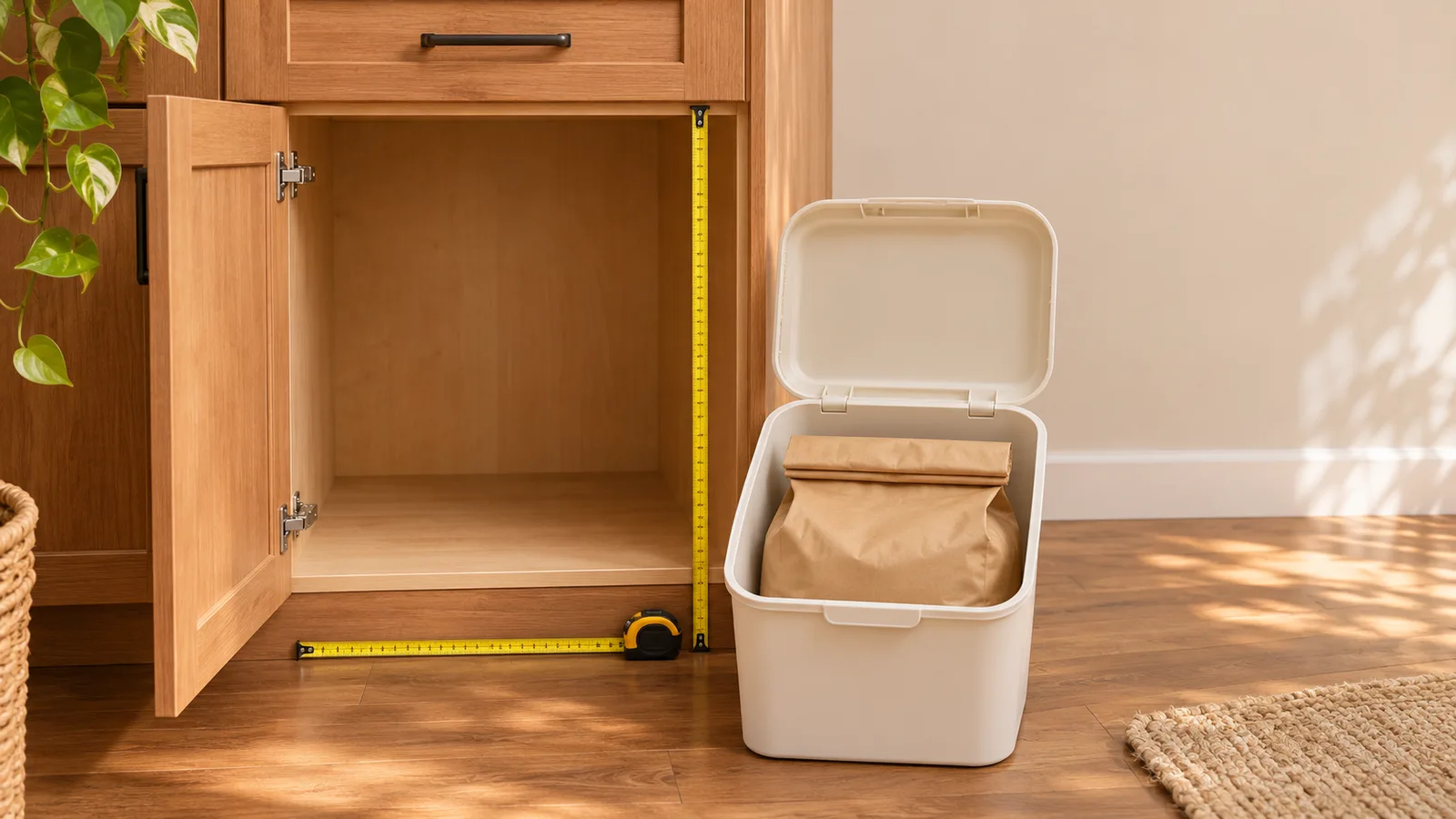
Keep the bag before you buy a bin. If your cat’s or dog’s dry food will not fit in its usual cabinet, first try a different cool, dry, secure indoor spot or a smaller bag next time. A container that holds loose kibble may not hold the original package, and its lid still needs room to open.
This is a storage-planning guide for dry food. Follow the food label for handling instructions; wet, raw, and refrigerated foods need a different plan.
Make the bag part of the measurement
Leave the food in its package while you work out the arrangement. The FDA recommends keeping pet food in its original packaging. For an outer container, its preferred approach is to put the bag inside. The label also preserves product details you may need later.
The following fit-check process is our editorial planning advice, not a manufacturer specification or a tested storage system. Measure the bag as it actually stands, including the closed top. Then check three movements: getting it into the cabinet, opening it to scoop, and taking it back out. A bag that clears the doorway but must be wrestled out for every meal has not solved the daily problem.
If you already own a container, try the bag inside it before committing to the arrangement. If you have not bought one, compare its internal dimensions and opening with your bag measurements first. Do not rely on a “pounds of food” capacity claim as proof of bag fit. Package shape and the opening matter too. This is a practical fit check, not a tested capacity formula.
Choose the least disruptive fix
| What is failing? | Try first | Stop if… |
|---|---|---|
| The bag is too tall | Another suitable shelf or a container with enough headroom for the closed bag | You must leave the food open to make it fit |
| The cabinet opening is too narrow | A different secure indoor location | Moving it puts food beside cleaning chemicals or within your pet’s reach |
| The lid hits the shelf above | A container you can remove comfortably before opening | The full container is awkward to lift or blocks the walkway |
| The bulk bag takes over the room | Compare smaller packages of the same appropriate food for the next purchase | Storage savings depend on an unverified claim about how long opened food lasts |
You do not need a matching feeding station. Use a location that works through an ordinary meal: retrieve, open, measure, close, return. Our pet-supply storage guide handles the rest of the cabinet; this check is specifically about an awkward food bag.
A container to compare after measuring your bag
If you want a dedicated outer container for your original food bag, consider the simplehuman Large Pet Food Can in Brushed (CW1886). Its removable inner bucket gives you a separate container to check against the closed bag before choosing a location.
Measure the bag’s width, depth and closed height, then check the bucket interior and opening—not just the can’s outside dimensions. We have not verified the usable interior or opening dimensions, so the advertised food capacity does not establish whether your bag fits. Leave room to open the lid and remove the bag without an awkward lift. Keep the bag-in-container setup in a cool, dry, secure indoor spot.
Choose it only when those checks work for your bag and space. If your current container already does that job, keep it. This is a research-based option, not a tested fit or a freshness guarantee.
As an Amazon Associate I earn from qualifying purchases.
simplehuman Large Pet Food Can — Brushed, CW1886
The inner bucket can be removed for access.
Usable interior and opening dimensions remain undocumented. Measure your bag and confirm fit; food-weight capacity does not guarantee bag fit.
If you buy through this affiliate link, we may earn a commission.
View on AmazonIf you already poured the food into a bin
The FDA allows for pouring dry food into another container: use one that is clean and dry, with a snug-fitting lid. Save the UPC, lot number, product name, manufacturer, and best-by date; attach those details to the container and update them with each new bag. Between bags, wash the container and let it dry completely before refilling.
Keeping the original bag inside an outer container remains the FDA’s preferred approach. Follow the food maker’s handling instructions rather than assigning a universal freshness deadline.
For this apartment setup, choose bag-in-bin storage where it works. If it does not, ask the food manufacturer about the intended container and your specific food before improvising a split-storage system. A tidy counter is not a reason to lose track of which food is in which container.
An automatic feeder does not solve the whole bag
Before choosing a feeder, account for the food that stays outside its hopper. Set aside a suitable place for the original package, and check the exact feeder’s food compatibility and cleaning instructions. Do not assume hopper capacity tells you how long food can remain there.
Our smart-feeder buying guide can help if scheduled dispensing is a separate problem you actually need to solve. If your only problem is a bag that will not fit, start with the shelf and the package size. You may not need new equipment at all.
Before your next food purchase, write down the usable opening, the available headroom, and the bag size that worked. Those three notes are more useful in a store than the promise of a perfectly organized pet corner.