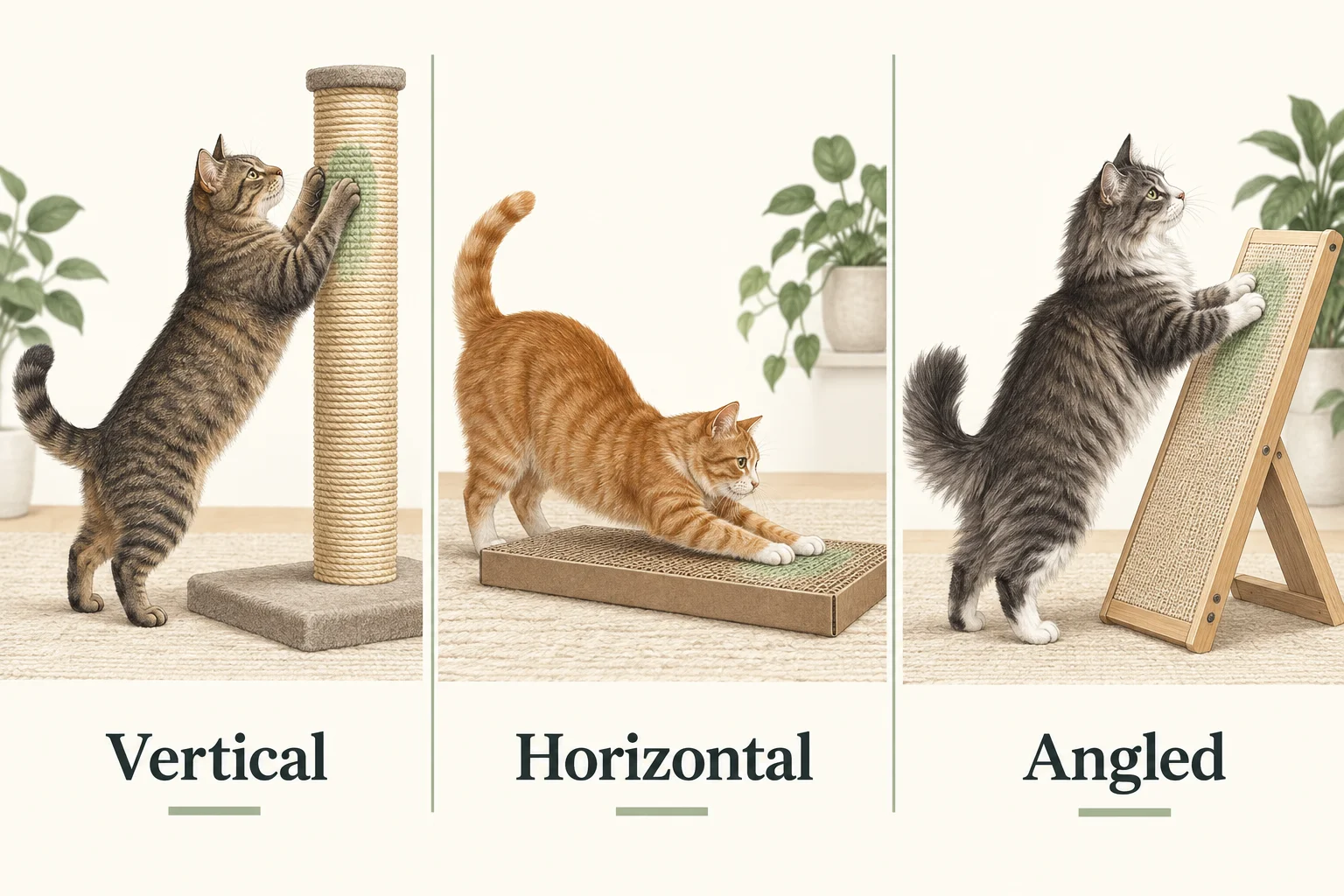
Start with a vertical scratcher if your cat reaches up to scratch; start with a horizontal one if your cat stretches forward along the floor. Then check the surface and the room. A tall post with only a short band of scratching material can be a poor match, and a flat pad that slides across the floor needs more scrutiny than its compact listing photo suggests.
If you already own an unused scratcher, inspect it before ordering another. The problem may be its material, movement or access rather than its direction.
Use posture as a clue, not a verdict
Watch an ordinary scratching session without moving your cat into position. Note where the front paws travel, where the back feet stay and what material the claws engage. A sofa arm and the rug beside it offer different postures, but they also offer different textures.
SF SPCA’s scratching guidance distinguishes cats that rear up and pull from those that stretch along the floor. That makes posture a useful starting point. It does not establish that a cat scratching carpet will reject every upright surface.
Separate two questions in your shopping notes: Which direction does my cat use? Which surface does my cat use? Sisal is a material; vertical is an orientation. Cardboard can be offered flat, upright or at an angle. Replacing an upright sisal post with a flat cardboard pad changes both variables, so any new interest cannot tell you which change mattered.
If you have suitable alternatives already, compare one difference at a time where practical. You do not need to buy a matching collection to prove a preference.
Compare the usable surface before the overall size
| Format | Worth considering when | What to verify before buying | Reason to pause |
|---|---|---|---|
| Vertical post or board | Your cat reaches up and pulls down | Continuous scratchable height; assembled base; room to stand at the face; assembly or mounting requirements | Most of the listed height is a perch, cap or bare support, or stability information is unclear |
| Horizontal pad or mat | Your cat stretches forward and rakes a floor surface | Exposed scratching length and width; raised borders; backing or holder; whole floor footprint | The usable center is much smaller than the outer dimensions, or sliding remains unresolved |
| Angled board | Your cat uses a sloped surface, or a properly sized flat/upright option has not suited the observed posture | Length along the slope; support underneath; base depth; whether the board is secured as intended | The ramp consumes the only walkway, or the listing gives only overall height |
These are buying checks, not tested performance ratings. No format guarantees that a cat will leave furniture alone.
Compare Cat Scratcher Options
These two cardboard options offer different layouts. Check the selected configuration and exposed scratching area before ordering; neither is a tested solution for furniture scratching.
As an Amazon Associate I earn from qualifying purchases.
Poils bebe L Shape Cat Scratcher
Cardboard scratcher; selected 1 PCS L Shape Cat Scratcher configuration.
For: Upright and floor scratching in one L-shaped structure
Watch for
- Check usable scratching area and assembly instructions; listed heights conflict.
If you buy through this affiliate link, we may earn a commission.
View on AmazonCheck the retailer for the current price.miwoowim 3-Piece Cat Scratcher Set
Two oval scratching beds and one box; observed khaki small configuration.
For: Separate low-level scratching surfaces
Watch for
- Check each piece’s scratching area and the space needed for the full set.
If you buy through this affiliate link, we may earn a commission.
View on AmazonCheck the retailer for the current price.Vertical: count the scratching material, not the top of the post
SF SPCA recommends an upright surface that is sturdy and allows the cat to stretch. Translate that into a specific question for the listing: where does the scratchable section begin and end?
Compare that section with the reach you observe during normal scratching. Do not stretch your cat against a tape measure. If the seller lists only total height, look for a dimensioned diagram or ask for the usable height before ordering. A decorative cap does not extend the scratching face.
Check the base in the assembled configuration. A narrow base may fit between a sofa leg and a wall yet leave too little room for the cat to stand squarely at the post. A larger base might fit the room better if it provides an accessible face outside the walking route. Base size alone does not prove stability: construction, connections and installation also need checking.
For an existing post, follow its assembly instructions and inspect loose connections before judging whether the cat dislikes upright scratching. Do not improvise heavy weights or brace an unsuitable structure against furniture. Wall-mounted designs require compatible mounting and permission to install them; saving floor space does not establish that a particular installation will hold.
Horizontal: measure inside the border
For a pad in a tray, compare the exposed insert with the outer tray dimensions. Raised ends, a wide frame or a curved center can change how much uninterrupted surface is available. Look for room for the posture your cat actually uses, including where the hind feet rest.
Then consider your floor. Check what the manufacturer provides to limit movement and whether it is suitable for that surface. If a pad moves during voluntary use, resolve that according to its instructions before deciding your cat dislikes flat scratchers. Flat does not mean immovable.
A low pad still occupies floor space. Measure its full length and width beside the sofa, including the area needed to approach it. If it fits only when pushed under the furniture, check whether that hides the scratching area or blocks the cat’s stance.
Cleanup belongs in this decision too. Check whether the insert can be removed, whether replacements fit the exact holder and how the manufacturer says to clean it. Do not assume cardboard can be washed. Think about whether you can lift the pad and reach the debris underneath without shifting the sofa.
Angled: a separate option, not an automatic compromise
An angled board is worth considering if you have seen your cat scratch a sloping surface, or want to offer a different posture after checking the current setup. It is not necessarily the halfway solution for every undecided cat.
Measure the scratching face along the slope and the footprint along the floor. Those are different dimensions. Also check how the support keeps the board in its intended position. Do not lean a flat pad against a wall unless its instructions allow that configuration.
Veterinary behaviorist Jeannine Berger’s SF SPCA advice published by 7x7 includes angled surfaces among the options to observe and compare. It does not establish a universal preferred angle.
Before replacing an ignored scratcher
Work through the setup in an order that avoids unnecessary purchases:
- Inspect the structure. Check assembly, mounting and damaged parts against the instructions. A loose post or shifting pad needs attention before you assess preference.
- Check the available face. Is the material reachable, or crowded by a chair leg, wall corner or furniture base? Does the cat have room for the posture you observed?
- Separate material from direction. A cat choosing upholstery over sisal has not necessarily rejected vertical scratching. Record both differences before deciding what to change.
- Check access and location. An otherwise suitable scratcher may be inconvenient to use. Our guide to where to put a scratching post in a small apartment handles that room-layout decision in detail.
- Observe voluntary use after a specific change. Note what changed and what the cat did. Avoid rearranging the room, switching materials and changing angles together if you want a useful comparison.
Reward voluntary scratching. Do not drag your cat’s paws along the surface; ASPCA warns that forcing this contact can frighten a cat. Persistent difficulty is a reason to seek qualified behavior help, rather than keep buying increasingly elaborate furniture.
When you can leave the shopping cart empty
Keep a scratcher that your cat uses and that remains structurally sound, even if its surface looks scruffy. ASPCA advises against discarding a familiar favorite simply because it looks worn. Cosmetic wear and a failing support are different decisions; follow the manufacturer’s inspection and replacement directions.
You also do not need an additional orientation just to complete a set. If the existing option supports the scratching you observe and fits the room, another purchase needs a specific purpose. If your cat regularly uses both upright and floor surfaces, offering both is reasonable—but there is no need to remove a successful post to make room for a pad.
Before checkout, write a short shopping note: the posture you want to accommodate, the material to try, the usable face dimensions you need confirmed and the assembled space available. If the listing cannot answer those questions, keep looking. A label such as “apartment friendly” cannot answer them for you.
Research notes
This is a source-based category comparison, not a product test. The two model options use listing information and Owner browser evidence; no measured outcomes are claimed. The measurement and troubleshooting workflow is editorial advice informed by the sources linked above; it is not a tested method for predicting preferences. Preferences vary between cats. No age-based orientation rule, universal size threshold or furniture-protection guarantee is claimed. Sources were reviewed October 19, 2026.